
Home  |  Services  |  Educational Outreach |  Products |  About Us |  Contact

Tips for Successful Moss Gardening

You can be a successful moss gardener yourself if you follow just a few tips. Moss requires almost zero maintenance yet yields an aesthetic beauty you will appreciate. The sustenance for moss in nature is rainfall and dust particles. Yes, that's all. However, supplemental watering is recommended in times of low rainfall or drought to ensure your moss garden stays lush and green throughout all seasons.

Remember... although many mosses prefer shady areas, there are types that are not only sun-tolerant, but are true direct sun lovers. Assessing your environment and choosing the appropriate moss for your conditions is advised. Picking the right bryophyte for the right spot is the first step!

You'll find helpful hints in this section. NEW: Winter Moss Gardening and Featured Moss of the Month- Leucobryum glaucum 

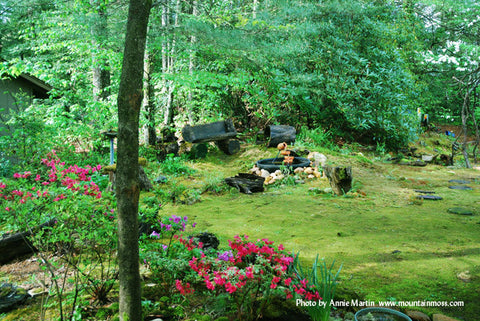
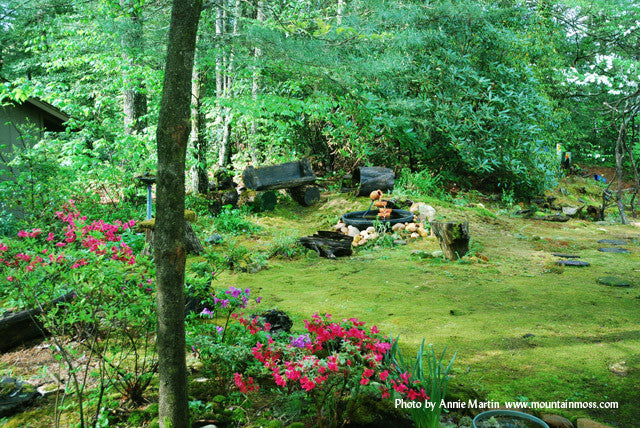
Azaleas Moss instead of Mulch             

Moss instead of mulch          Direct sun along driveway     Moss integrated with native plants

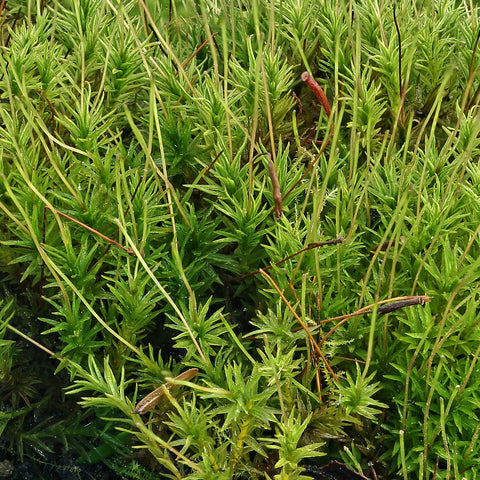
                                                        Sporophytic stage offers glimmers of gold and red!


Winter is a good time to harvest and plant mosses...

That is, if you don't have snow on the ground during the entire season. In the mountains of WNC, as with other places, we've had record snowfall this year and so mosses have been covered for a while. The brutal temperatures have not been conducive to planting because it's just too cold (for people, not mosses... at least this year). Last winter, I expanded my own moss garden between November and early January reclaiming a section of asphalt driveway. Over a year later, this moss garden retreat is still thriving, albeit under the snow at the moment. When the snow melts, the mosses around here are still green. In contrast, my bryologist friend, Janice Glime in Michigan, reports her mosses are brown but rejuvenate with new green growth in the spring.

Mosses don't mind freezing. In fact, research indicates that mosses grow in temperatures way lower than other vascular plants which go dormant with temperatures less than 55-65 degrees Fahrenheit. Mosses are actually still growing when temperatures hover around freezing! One recent research project was examining microscopic growth occurring at temperatures far below zero. You can plant moss on frozen ground. I know, I've done it. But, the moss needs to be thawed out first.

One hampering factor to winter moss gardening is that most people turn off outside water sources to prevent the bursting of frozen pipes. Water and walk on your mosses is my motto for planting. This process helps ensure the successful establishment of moss colonies. Even in the winter, you still need to water and walk on your mosses. So, on warmer days, when temperatures are above freezing, hook that garden hose back up so you can water and walk on your winter moss garden, especially during the first few weeks after planting. Don't forget to remove the hose again after this occasional use.


Studies are inconsistent in determining exact growing seasons but there is no doubt that mosses grow in opposite seasons to most plants, even in the winter. Bryologists have documented growth in the fall, winter and spring, with summer being the least desirable growing season due to higher temperatures resulting in lower humidity. I can guarantee there is visible evidence in the spring that Thuidium, last newsletter's featured moss, has been growing in leaps and bounds during the winter months. It spreads over other types, like Leucobryum and Dicranum, invading and sometimes covering these mound mosses resulting in a more homogeneous moss carpet. Winter growth can dramatically change your moss landscape design.


SITE EVALUATION 

A site evaluation is advised:
    To determine what bryophytes might already be growing
    To assess your environmental conditions, i.e., amount of sunlight, humidity, soil status, etc. 
    To envision how mosses can complement existing plant population
    To start your creative processes flowing

SOIL PREPARATION 

Bryophytes usually require very little soil preparation, if any... at least around here. It is highly recommended that you send soil samples to your state extension service for analysis. In North Carolina, this is a free service. Generally, moss requires a PH of 5.5 but there are always exceptions to the rules. If you have gravel, red clay, rich loam, or even "cruddy dirt", moss can probably grow. 
Clear your soil of any debris all the way down the plain dirt. Don't dig any holes... just clear a spot. 
If you have used mulch in the past, make sure it is completely removed. Voice of experience...       
Don't even bother to loosen the soil or scrape it... hard surface dirt works just fine.    
Amend soil, only if really required, based on soil test results.

PREENING YOUR MOSSES

I always preen my mosses before planting... that means, I remove any ugly debris, weeds or grass already growing in them. The preening process reduces the need for much weeding later on. This extra step enhances the beauty of your moss garden from the very beginning. 

PLANTING YOUR MOSS GARDEN

Are you ready? YES, you are! Just place moss directly on the ground. It can be that simple. However, creating a synergy and an aesthetically pleasing design doesn't just happen... it flows!
Water your mosses when planting to get them established. Walk on them, too. Sit on them. Enjoy your mosses. These activities will not harm your moss plants and I've found them to actually help in the success of my moss garden.

MAINTENANCE 

Mosses require almost zero maintenance but my kids would never believe that statement since I find excuses to stay in my moss garden for hours.
LEAF REMOVAL: Biggest moss chore is removing leaves in the fall/winter. Although some leaf litter might be tolerable (obviously no one removes the leaves in the woods), mosses do much better when leaves are not present. Not a good idea to rake them though since mosses have no real roots and can dislodge from their spot with a rake. I recommend a leaf blower. Once established the mosses should remain intact and the leaves blow away as desired. FYI: Occasionally a little mound might roll down the hill. Oops!
WEEDING:  If you preen, you won't have very many weeds. Of course, you will periodically need to weed (invaders still try to sneak in) but it is fairly easy if you catch any stragglers in between main weeding times. I weed after winter around April. Then in late May, I will need to weed out all the bluets I let grow for their precious little flowers. Most weeds are unwanted "wild" flowers and only on a rare occasion will grass leaves pop up through my mosses.
Another FYI: Bluets will invade your mosses. They grow prolifically on top of the moss and are a lot of trouble to get rid of after blooming season. I advise against planting them in your moss garden. I can't get rid of them. Come back each year and I give in and let them grow because bluets used to be used as a nosegay by mountain brides... how's that for a reason? 
WATERING: Rainfall is all that is technically needed. But, I like my moss garden LUSH so I water as a supplement. I power squirt not just mist. That's another way I remove leaves by blowing them away to the edges with the water hose. Mosses can be watered at any time of the day or night. Sometimes I water at high noon... leaves don't burn. Sometimes I water at midnight... leaves don't mold. I water whenever mosses are starting to get too dry. Certain mosses are great indicators of when you need to water like Leucobryum and Sphagnum mosses. I hope to add a rain barrel misting system but then that would take away my pleasure from mindless watering. It is so relaxing to me.
Please Note: If you have city water, it could contain chemicals that aren't great for your mosses. A rainwater system could be a better alternative. 
SOIL SUPPLEMENTS/CHEMICALS: It is unnecessary to fertilize moss after you have your initial soil amendment. In the early years of my moss gardening, I did think it seemed like a good idea to water with a water soluble fertilizer. Later, a bryologist was amazed I hadn't killed all my mosses. Thank goodness I didn't.
BAD WEATHER: No need for you to worry if mosses freeze. Even snow is not an issue. Once it melts, the mosses are just greener for added delight in the winter! Your worst enemies will be drought and low humidity.
PLANTING SEASON: There is no real planting season for mosses since they don't reproduce with flowers and seeds. Because there are no real roots, it doesn't matter if the ground is frozen. However, it stands to reason they would do better when the surface ground is thawed. Mosses actually thrive in the winter and many continue their reproductive cycle sporting their sporophytes. Winter months are a great time for rescue of mosses from the woods because other plants have died back and the bright green pops out among the dead leaves of other plants. ALWAYS practice responsible land stewardship... NEVER take mosses from our national, state or local forests and parks. Hot summer would be the least desirable time to plant moss but works if you water faithfully. It is best to plant early in the morning when the dew is still on the ground or plant at night under the moon.

Although this seems like a lot of advice for a plant that truly requires very few horticultural skills and very little maintenance, I hope these guidelines will be helpful. Enjoy creating your own moss garden. And then enjoy being in it at all times of the day and night for it changes dimensions and character. In the winter, you will delight at year-round green mosses instead of mulch or dead leaves like your neighbors.  


Featured Moss of the Month- Leucobryum glaucum

ID-LeucobryumG-1.jpg  ID-LeucobryumG-6WEB.jpg  

Leucobryum glaucum is one of my favorite mosses. A common moss, it is easily recognizable by its pincushion appearance. The common names are cushion, pincushion or white moss. It is an acrocarpous moss, or mound type, growing primarily on a variety of soil substrates. It may be found in the shade but it can tolerate sun exposures. Because the new colonies start off in a round stage, looking like a pincushion, it makes a striking element in garden designs and borders. Also, as one of the lightest greens, it makes a great contrast to other mosses emphasizing design elements.

We often make the assumption that mosses grow only in the shade and in the deep woods. This moss grows in a variety of environments. Sure, it grows in the forests. But, it survives in urban areas as well. Not just a mountain moss, I've seen it growing in the piedmont and even at the beach. It can be found growing all around the world not just in North Carolina. Soil substrates range from rich loam to sandy gravel. As with most mosses, it mainly grows on soil that is less desirable for other vascular plants.

Although I talk about the year-round green of mosses, there are times when it may change appearance losing its brilliant shade of green. Of course, climate plays a role. If the humidity level drops and the moss colony is dry over a period of time, Leucobryum glaucum gets lighter and lighter until it becomes almost devoid of green color, looking “white-ish.” Hence, the Latin “leuco” meaning white. The reason this dramatic color change occurs is that Leucobryum g. is the exception to the “single cell layer of the leaf” rule. When its top layers dry out, they become opaque blocking the green chlorophyll in lower layers. It is not uncommon for this moss to become lighter on hot days or during periods of drought. I use it as an indicator of when it is time to water my moss gardens. It is amazing to watch this moss change before your eyes as it rehydrates. Once I rescued a Leucobryum colony from a gravel road in the direct sun. It was truly white. I took it home and placed it among other Leucobryums in my garden. I watered it thoroughly on three separate occasions that evening. By morning, if I hadn't known exactly where I put it, I would not have been able to distinguish it from the established Leucobryum colony.

However, Leucobryum g. changes appearance for another reason, too. During its asexual reproductive stage, the top leaves break off, covering the colony with white fragments for dispersal to other areas via the wind. Don't be worried, it is not dying but it does look cruddy for a while. Using a broom, lightly sweep them off and they'll look better, and you'll be helping Mother Nature spread the moss to new locations. Sometimes I squirt them with the garden hose creating rivers of white in the miniature landscape spreading them in this manner. If conditions are right, each Leucobryum fragment can grow into a new moss plant.

Warning: If Leucobryum g. gets “black-looking,” it might be suffering from prolonged wet conditions or maybe it has been compromised by disease or mold. Let it dry out and see if it starts to recover. This moss does not like staying drenched or soaked for long periods.

As for the tactile aspect of Leucobryum, it grows in a tight mound. Although the plant is relatively small, it does not feel velvety like the tiny Bryums. Large mounds, or older specimens, are compact and hard feeling when dry. Younger colonies, especially when wet, are like walking on a firm sponge. I normally, recommend walking on mosses right planting and watering, to help them attach to the surface. However, I avoid walking on the big colonies with heights of 4-5” because it compromises their round shape. When you walk on smaller cushions, it helps them blend together.

When retrieving Leucobryum, it is easy to pick up a pincushion without any special technique. Rarely, will soil be attached since most colonies grow on top of older generations. As always, please practice responsible land stewardship. Don't take any mosses from our parks or forests and always ask your neighbor before gathering these delightful plants for your own yard.

FUN FACT! Leucobryum grows from both sides! There is no top or bottom to the colony like we associate with other plants where there is no doubt the top is the flower and the bottom is the root system. If you flip over a Leucobryum pincushion, it will start growing from the bottom and turn green. On rare occasions, I've found a Leucobryum “cookie,” that is green and growing on all sides. How is it possible for any plant to grow from either direction? Indeed, Leucobryum mosses are botanical magicians!


If you desire the design services of Mountain Moss Enterprises in conceptualizing and creating a customized moss garden for your home or business, please contact Mossin' Annie.